
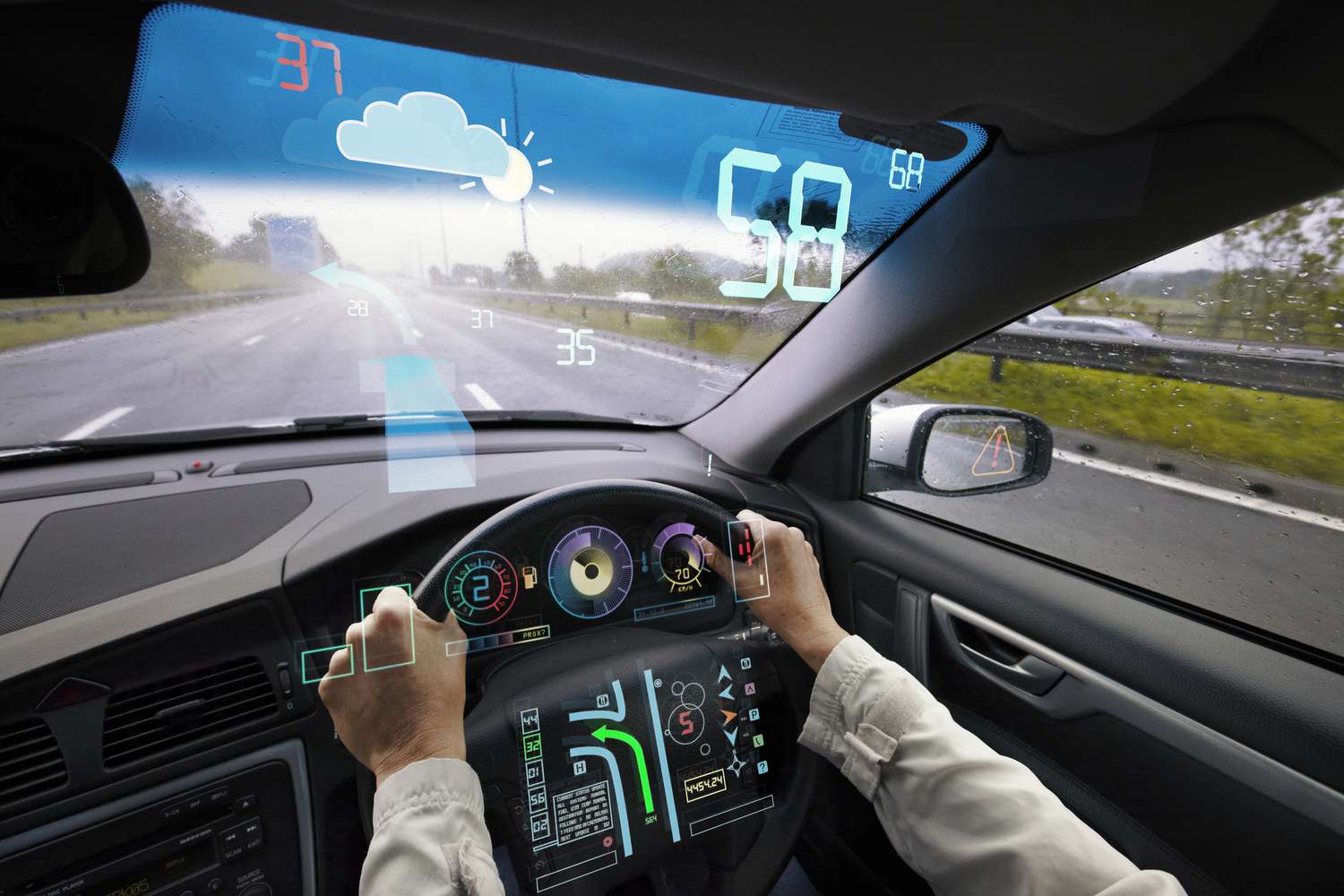
Augmented Reality (AR) is redefining how drivers interact with vehicles, and one of its most impactful applications is within automotive Head-Up Displays (HUDs). Once limited to basic speed readouts, modern HUDs now project intelligent, context-aware visuals directly onto the windshield, blending digital information seamlessly with the real world. This evolution is reshaping safety, navigation, and the overall driving experience.
Understanding Automotive Head-Up Displays
A Head-Up Display projects essential driving information into the driver’s line of sight, reducing the need to glance away from the road. Traditional HUDs typically display speed, warnings, or cruise control status. With the integration of augmented reality, these displays become far more dynamic and intuitive.
AR-enabled HUDs overlay digital graphics—such as navigation cues or hazard alerts—directly onto real-world objects like roads, lanes, or nearby vehicles. This spatial alignment makes information easier to interpret in real time.
How Augmented Reality Enhances HUD Technology
Augmented Reality transforms HUDs from passive information panels into interactive driving assistants. Instead of abstract icons, AR systems anchor data to the environment outside the windshield.
Key enhancements include:
-
Context-aware navigation with arrows aligned to actual roads and intersections
-
Object recognition, highlighting pedestrians, cyclists, or vehicles
-
Lane-level guidance that adapts to traffic and road conditions
-
Predictive alerts that anticipate hazards before they become critical
By merging sensor data, cameras, GPS, and AI, AR HUDs provide a more natural and intuitive flow of information.
Benefits of AR-Integrated Head-Up Displays
Improved Driver Safety
Safety remains the primary driver behind AR HUD adoption. By keeping vital information within the driver’s field of view, these systems help reduce cognitive load and reaction time.
Notable safety benefits include:
-
Fewer distractions caused by looking down at dashboards or infotainment screens
-
Real-time hazard warnings aligned with the driver’s surroundings
-
Enhanced night and poor-weather visibility through highlighted objects
Enhanced Navigation Experience
Traditional navigation systems require drivers to interpret maps and symbols. AR HUDs eliminate this guesswork by projecting turn-by-turn directions directly onto the road, making complex intersections and highway exits easier to navigate.
Better Situational Awareness
AR HUDs synthesize data from multiple vehicle systems, providing a unified view of the driving environment. Drivers gain clearer insight into speed limits, following distances, and potential dangers without information overload.
Key Technologies Behind AR Head-Up Displays
The effectiveness of AR HUDs depends on several advanced technologies working together:
-
High-resolution projectors capable of large, bright windshield displays
-
Depth-sensing cameras and radar for object detection and tracking
-
Artificial intelligence for real-time scene interpretation
-
Precise vehicle positioning systems to ensure accurate visual alignment
Together, these components enable AR graphics to remain stable and correctly positioned, even at high speeds.
Challenges in Implementing AR HUDs
Despite their advantages, AR HUDs face several technical and practical challenges.
Calibration and Accuracy
For AR visuals to align correctly with the real world, systems must be precisely calibrated. Even small errors can lead to misplaced graphics, which may confuse rather than assist drivers.
Cost and Complexity
Advanced hardware, sensors, and software increase production costs. While luxury vehicles have adopted AR HUDs more rapidly, scaling the technology for mass-market cars remains a challenge.
Driver Overload Concerns
Poorly designed AR interfaces risk overwhelming drivers with too much information. Automakers must balance useful data with visual simplicity to maintain safety.
The Future of AR in Automotive Displays
As vehicles move toward higher levels of automation, AR HUDs are expected to play an even greater role. Future systems may:
-
Adapt displays based on driver behavior and preferences
-
Integrate with vehicle-to-everything (V2X) communication
-
Provide immersive guidance during autonomous or semi-autonomous driving modes
With ongoing advances in display optics and AI, AR HUDs are likely to become a standard feature rather than a premium add-on.
Frequently Asked Questions (FAQ)
What is the difference between a traditional HUD and an AR HUD?
A traditional HUD displays static information like speed or warnings, while an AR HUD overlays graphics directly onto real-world objects, making information more intuitive and context-aware.
Do AR Head-Up Displays work in all weather conditions?
Most systems are designed to function in rain, fog, and low light, though extreme conditions may reduce visibility or sensor accuracy.
Are AR HUDs distracting for drivers?
When designed correctly, AR HUDs reduce distraction by keeping information in the driver’s line of sight. Poor interface design, however, can create visual clutter.
Can AR HUDs be added to older vehicles?
Aftermarket HUD solutions exist, but true AR HUDs require deep integration with vehicle sensors and cameras, making retrofitting limited.
How large is the display area of an AR HUD?
Modern AR HUDs can project images that appear several meters ahead of the vehicle, spanning a wide portion of the windshield for better immersion.
Do AR HUDs improve driving safety?
Studies suggest they can enhance reaction time and situational awareness by presenting information more naturally, though driver behavior and system design remain critical factors.
Will AR HUDs become standard in future cars?
As technology matures and costs decrease, AR HUDs are expected to become increasingly common, especially as vehicles adopt more advanced driver-assistance features.
